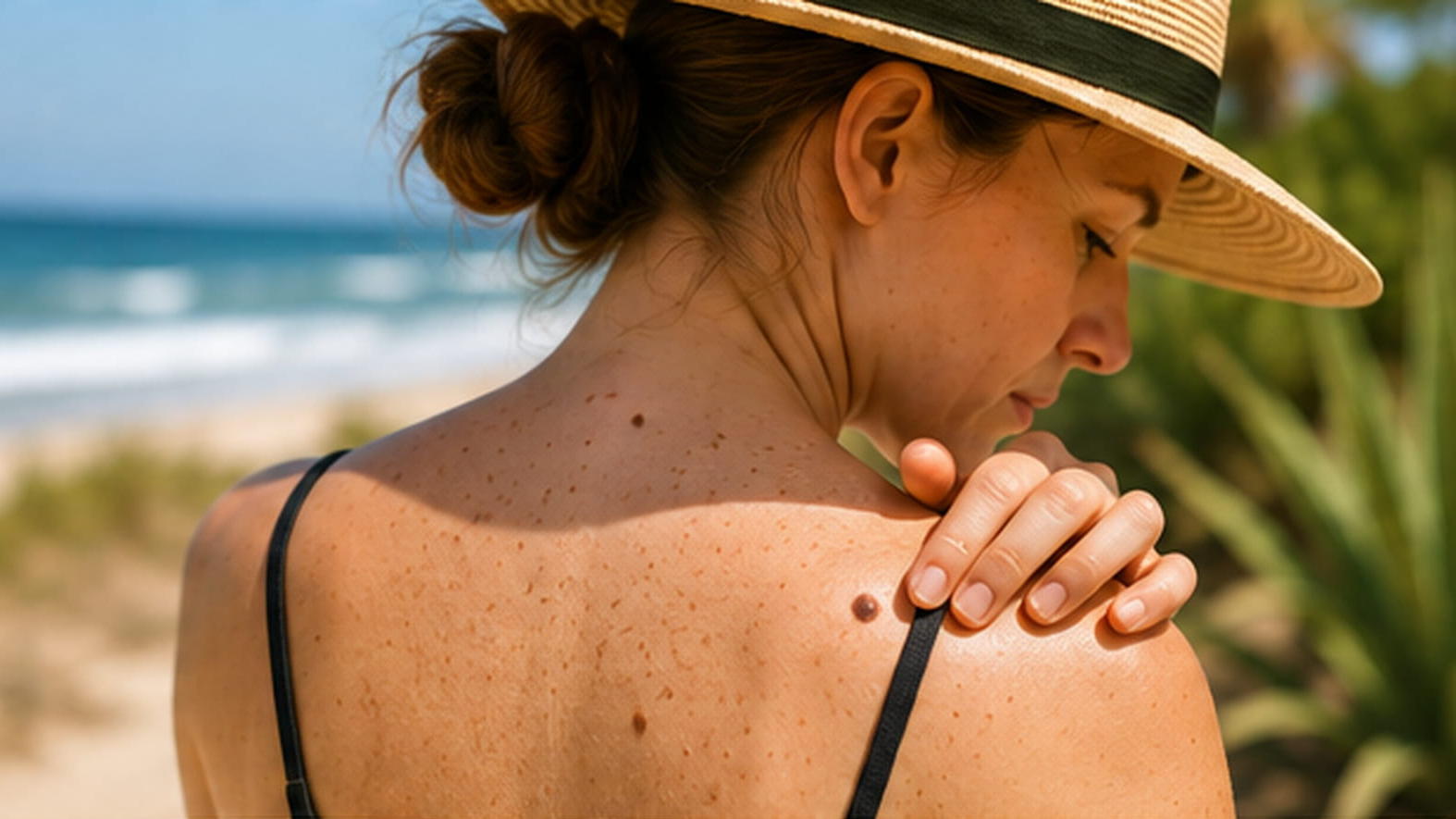
What to look for, how often to check your skin, and how to lower your future risk
Australia has one of the highest burdens of skin cancer in the world.
Most skin cancers are linked to ultraviolet, or UV, radiation. The encouraging part is that much of this exposure is preventable, and skin cancers found early are often easier to treat.
A good skin-cancer strategy therefore has two parts:
protect your skin from further UV damage, and know enough about your own skin to notice when something changes.
You do not need to become obsessed with every mole. But you should know what deserves a closer look.
What are we actually looking for?
There are several types of skin cancer.
The three most important are:
- basal cell carcinoma (BCC)
- squamous cell carcinoma (SCC)
- melanoma.
BCC and SCC are sometimes grouped together as keratinocyte or non-melanoma skin cancers.
Melanoma is less common than BCC or SCC but is particularly important because it can spread to other parts of the body.
The appearance can vary considerably, which is why skin checks are not only about looking for dark moles.
What can melanoma look like?
A melanoma may develop in an existing mole or appear as a completely new spot.
A useful rule is the ABCDE guide:
- A — Asymmetry: one half looks different from the other
- B — Border: irregular, blurred, ragged or uneven edges
- C — Colour: several colours or uneven colour
- D — Diameter: a larger lesion may deserve attention
- E — Evolving: the spot is changing in size, shape, colour or behaviour.
Melanoma is not always black. It may be brown, pink, skin-coloured or contain several colours.
Of all these features, change is particularly important.
A spot that is getting larger, darker, thicker or otherwise changing deserves assessment.
The “ugly duckling” rule
There is another useful idea that is often easier than memorising letters.
Most of your normal moles tend to resemble one another.
A spot that looks noticeably different from the rest can therefore stand out like an ugly duckling.
If something simply looks different from your other spots, it is reasonable to have it checked.
You know your own skin better than anyone else.
Skin cancer is not always a mole
This is important.
BCC and SCC often look nothing like the classic picture of melanoma.
See your GP if you notice:
- a sore that does not heal
- a spot that repeatedly bleeds or crusts
- a new lump
- a persistent rough or scaly patch
- a shiny or pearly-looking bump
- a spot that becomes tender or itchy
- a lesion that keeps growing.
Do not wait for something to become dark or dramatic before having it assessed.
Who is at higher risk?
Anyone can develop skin cancer.
Risk is higher if you have:
- fair skin that burns easily
- red or fair hair
- many moles
- unusual or atypical moles
- a previous melanoma or other skin cancer
- a strong family history of melanoma
- significant sun exposure over your lifetime
- repeated sunburn, particularly earlier in life
- a weakened immune system.
People with darker skin can also develop melanoma and other skin cancers. No skin type is completely protected from UV damage.
Your personal risk matters because it influences how often professional skin checks may be worthwhile.
Does everyone need an annual skin check?
No.
There is no universal rule that every Australian adult needs a full skin check every year, and Australia does not have a population-wide national skin-cancer screening program.
The right approach depends on your individual risk.
Someone with few risk factors and no concerning lesions may not need the same surveillance schedule as someone who has previously had melanoma, has many atypical moles or has a strong family history.
People at higher risk may be advised to have professional skin checks every 6–12 months, sometimes with photography or dermoscopic monitoring.
skin-check frequency should be based on your risk, not simply on the calendar.
Ask your GP what interval makes sense for you.
What happens during a skin check?
A proper skin check usually involves systematically examining the skin for suspicious lesions.
Your doctor may look at areas including:
- scalp
- face and ears
- neck
- chest and back
- arms and hands
- legs and feet
- between the toes.
Depending on your history and risk, less obvious areas may also need examination.
A doctor trained in skin assessment will often use a dermatoscope. This is a handheld instrument that magnifies the lesion and uses specialised lighting to show structures beneath the skin surface more clearly.
Dermoscopy does not magically diagnose every lesion.
It helps the clinician decide whether a spot looks reassuring, needs monitoring or should be biopsied.
What about skin photography?
Photography can be useful when someone has many moles or is at higher risk.
This may include:
- photographs of an individual lesion
- serial dermoscopic photographs
- broader body photography to compare lesions over time.
The main advantage is comparison.
Instead of relying on memory, photographs can help show whether a mole has genuinely changed.
Not everyone needs total-body photography. It is most useful when the expected benefit justifies the additional monitoring and cost.
Does every suspicious mole need to be removed?
No.
Many unusual-looking spots turn out to be benign.
Depending on what your doctor sees, a lesion may be:
- considered reassuring
- photographed and monitored
- reviewed after an interval
- biopsied or removed.
The decision depends on the appearance of the lesion, whether it is changing, your risk factors and the clinician’s level of concern.
If a lesion has features that genuinely raise concern for melanoma, biopsy or removal is usually the safest way to establish the diagnosis.
Can a biopsy make melanoma spread?
No.
This is a persistent myth.
Biopsy is how melanoma and other skin cancers are confirmed. Removing or sampling a suspicious lesion does not make melanoma spread through the body.
Delaying assessment because of fear of biopsy is much more concerning than the biopsy itself.
How should I check my own skin?
You do not need to inspect every mole every day.
For many people, checking your skin every few months is more useful than checking obsessively. If you are at higher risk, your GP may recommend a more structured schedule.
A useful self-check is systematic.
Look at:
- your face and ears
- scalp where possible
- front and back of your body
- both sides of your arms
- palms and fingers
- legs
- soles of the feet
- between your toes
- areas that are difficult to see.
A mirror can help with your back, scalp and backs of the legs. A partner or family member can also help with areas you cannot easily inspect.
The aim is not to memorise every millimetre of every mole.
It is to become familiar enough with your skin to recognise change.
Should I photograph my own moles?
Sometimes this can help.
A clear photograph with the date recorded can make it easier to see whether a lesion has changed.
Try to use:
- similar lighting
- a similar angle
- enough context to identify where the lesion is
- a ruler or other scale when useful.
Smartphone photographs are not a substitute for dermoscopy or medical assessment.
If you are worried enough about a lesion to repeatedly photograph it, it may be better simply to have it examined.
Can an app diagnose skin cancer?
Be cautious.
Phone apps and artificial-intelligence tools may help organise photographs or remind you to check your skin, but they should not be used to rule out melanoma.
An image taken under variable lighting with a phone camera is not equivalent to a proper clinical examination and dermoscopy.
A reassuring app result should never override a lesion that is changing, bleeding, growing or simply looks wrong.
How do I reduce my future risk?
The biggest modifiable factor is UV exposure.
When UV levels reach 3 or above, use several forms of sun protection rather than relying on sunscreen alone.
Think: Slip, Slop, Slap, Seek and Slide
Slip on protective clothing.
Slop on sunscreen.
Slap on a hat.
Seek shade.
Slide on sunglasses.
Choose a broad-spectrum SPF50 or SPF50+ sunscreen. Use a water-resistant product when swimming, sweating or when prolonged exposure makes this useful.
Apply sunscreen generously to exposed skin and reapply as directed, especially after swimming, sweating or towelling.
People often apply much less sunscreen than the amount used during formal SPF testing. Real-world protection can therefore be lower than the number printed on the bottle.
Sunscreen is one layer of protection, not permission to stay in strong sun indefinitely.
What about tanning?
A tan is evidence that your skin has responded to UV exposure.
It is not a healthy shield against future damage.
Deliberately tanning to “build a base tan” simply adds more UV exposure.
Commercial solariums are banned in Australia.
What about vitamin D?
Sun protection and vitamin D sometimes seem contradictory.
The answer is not to deliberately burn or spend long periods unprotected in strong Australian sun.
Vitamin D needs vary according to season, skin type, location, clothing and other factors.
If there is genuine concern about vitamin D deficiency, it can be assessed and treated without deliberately increasing skin-cancer risk.
Is prevention still worthwhile if I already had years of sun exposure?
Yes.
You cannot undo past UV exposure, but that does not make future protection pointless.
Reducing ongoing UV exposure still matters.
Previous sun damage also makes early recognition of new skin cancers more important.
This is not an all-or-nothing problem.
Starting better sun protection at 50 is still better than waiting until 60.
Questions people commonly ask
I have lots of moles. Does that mean I will get melanoma?
No.
Having many moles increases melanoma risk, but it does not mean melanoma is inevitable.
It does mean that knowing your skin and discussing an appropriate surveillance plan with your GP may be particularly useful.
My mole has been there for 20 years. Can it still become melanoma?
A long-standing stable mole is generally more reassuring than one that is changing.
But any lesion that begins to change in size, shape, colour, thickness or symptoms deserves reassessment, regardless of how long it has been present.
Does melanoma always come from an existing mole?
No.
Melanoma can develop in an existing mole, but it can also appear as a new lesion on previously normal-looking skin.
That is why looking only at your old moles is not enough.
If my skin check was normal last year, am I safe until the next one?
Not necessarily.
A normal examination is reassuring at that point in time.
A new or changing lesion should be assessed when you notice it. Do not wait several months simply because your next routine skin check has not arrived.
Before your skin check
A little preparation helps.
If possible:
- remove nail polish if you have a concerning nail lesion
- avoid heavy makeup if facial lesions need examining
- know where any particular spots of concern are
- bring previous photographs or pathology results if relevant
- mention any previous melanoma or skin cancer
- tell your doctor about a strong family history
- point out lesions that have changed, bled, crusted or become symptomatic.
Do not assume the doctor will automatically know which lesion has been worrying you.
Point it out.
When should I arrange an earlier review?
Do not wait for a routine appointment if you notice:
- a new spot that looks unusual
- a mole that is clearly changing
- a lesion that looks different from your other spots
- a sore that does not heal
- repeated bleeding or crusting
- a rapidly growing lesion
- a spot that becomes persistently painful or symptomatic.
These findings do not necessarily mean cancer.
They mean the lesion deserves proper assessment.
Start with one action
Take five minutes this week and look over your skin somewhere with good light.
Do not try to diagnose anything.
Simply ask:
Is there anything new, changing or noticeably different from the rest?
If the answer is yes, show it to your GP.
The bottom line
Skin checks are not about removing every mole.
They are about identifying the right lesion at the right time.
Get to know what is normal for your skin. Pay particular attention to anything new, changing or different from the rest.
There is no universal rule that everyone needs an annual skin check. Professional surveillance should be matched to your individual risk.
Check your own skin every few months unless your GP recommends a different schedule.
And prevention still matters at every age.
Use good UV protection, avoid deliberate tanning, and have a new or changing lesion assessed when you notice it rather than waiting for your next scheduled check.
Related Q Guides
- Cancer Screening: What You Need and When
- Ten Things You Can Do Now to Improve Your Health
- Vitamin D: Who Needs Testing or Supplements?

Dr Quinten Willemse
Important information
This guide provides general health information and does not replace personalised medical advice. Speak with your GP or healthcare professional about recommendations appropriate to your medical history and circumstances.
Evidence and further reading
- Cancer Council Australia — Check for signs of skin cancer
- Cancer Council Australia — Early Detection of Skin Cancer Position Statement
- Cancer Council Australia — Skin cancer: causes, symptoms and risks
- Cancer Council Australia — UV Index and sun protection
- Melanoma Institute Australia — Checking Your Skin
- Healthdirect Australia — Skin cancer and melanoma
- Healthdirect Australia — Should I be checked for skin cancer?
- Healthdirect Australia — Moles