When to have a mammogram, what breast changes to notice, and why screening is different from investigating a symptom
Breast screening and breast awareness are related, but they are not the same thing.
A screening mammogram is designed to look for breast cancer in someone who feels well and has no breast symptoms.
Breast awareness means knowing what is normal for your own breasts and having a new or unusual change assessed rather than waiting for your next mammogram.
You need both.
A normal mammogram does not mean you should ignore a new lump. And feeling perfectly well is not a reason to skip routine screening when it is recommended.
Who should have routine breast screening?
In Australia, women aged 50–74 are actively invited to have a free mammogram through BreastScreen Australia every two years.
Women aged 40–49 and 75 years or older can also book a free BreastScreen mammogram, but the balance of benefits and limitations is different in these age groups.
In NSW, Aboriginal and Torres Strait Islander women are recommended to screen from age 40.
The practical rule for most women is:
If you are 50–74 and have no breast symptoms, a BreastScreen mammogram every two years should be part of your routine preventive healthcare.
Why does routine screening focus on ages 50–74?
Breast cancer becomes more common with age, and mammography works particularly well in this age group.
Younger women often have denser breast tissue, which can make cancers harder to distinguish on a mammogram. Breast cancer is also less common in younger women.
This does not mean women in their 40s cannot develop breast cancer or cannot be screened.
Women aged 40–49 can access BreastScreen, but it is reasonable to discuss your individual risk and preferences with your GP first.
What actually happens during a mammogram?
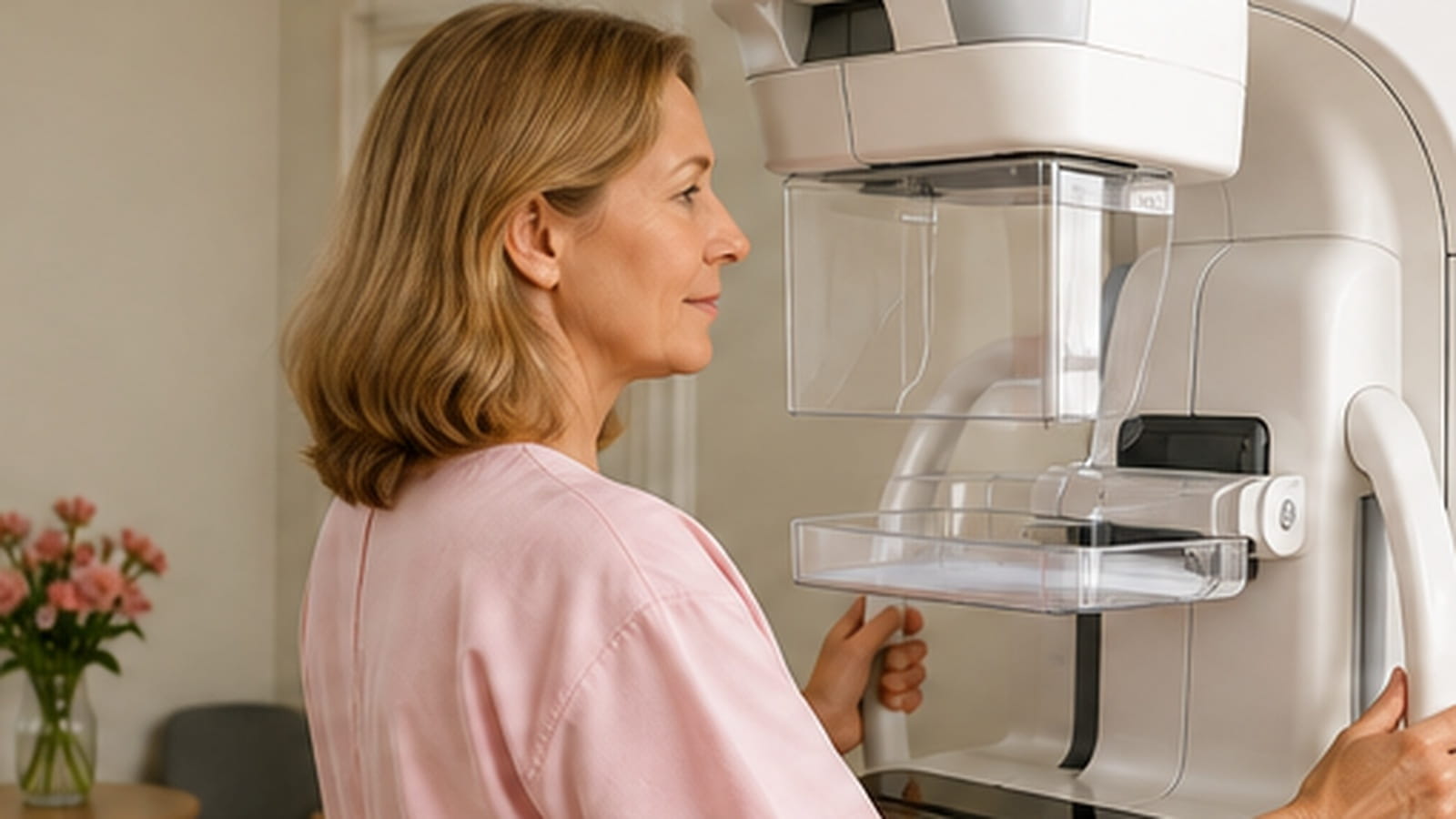
A mammogram is a low-dose X-ray of the breasts.
During the examination, each breast is positioned and compressed between two plates for a few seconds while the X-ray is taken.
The compression is important. It spreads the breast tissue out so the images are clearer and reduces the amount of radiation needed.
Many people describe the compression as uncomfortable, although some find it painful. The compression itself lasts only a few seconds at a time.
The entire appointment is relatively brief.
Why does the breast need to be compressed?
This is probably the least popular part of a mammogram, but there is a reason for it.
Breast tissue naturally overlaps.
Flattening the breast:
- separates overlapping tissue
- improves image quality
- reduces movement
- allows smaller abnormalities to be seen more easily
- reduces the radiation dose needed.
If previous mammograms have been particularly painful, tell the radiographer before the examination begins.
What is BreastScreen actually looking for?
A mammogram can detect changes that are too small to feel.
These may include:
- small masses
- distortions in normal breast tissue
- tiny calcium deposits called microcalcifications
- other patterns that deserve closer assessment.
Most abnormalities found on a screening mammogram are not ultimately breast cancer.
Screening is designed to identify anything that needs a closer look rather than diagnose every abnormality from the first image.
What happens if I am called back?
Being recalled after a mammogram understandably causes anxiety.
But a recall does not mean you have breast cancer.
You may need:
- additional mammogram images
- breast ultrasound
- a clinical examination
- occasionally a biopsy.
Around 90% of women who require further tests do not ultimately have breast cancer.
A recall therefore means:
“We need to look at this more carefully.”
It does not mean:
“We have found cancer.”
What if my screening mammogram is normal?
That is reassuring.
But mammography is not perfect.
No screening test finds every cancer, and a breast cancer can also develop between screening rounds.
That is why a normal mammogram should never be used to dismiss a new breast symptom.
If you develop a new lump or another persistent breast change after a normal screen, see your GP rather than waiting until your next mammogram.
What does “breast awareness” mean?
You do not need to perform a rigid breast self-examination on the same date every month.
There is no single special technique that has been shown to be best.
Breast awareness simply means becoming familiar with how your breasts normally look and feel.
This can happen naturally when:
- showering
- dressing
- applying moisturiser
- looking in the mirror.
The goal is not to search anxiously for cancer.
It is to notice when something is new or different for you.
What breast changes should I have checked?
See your GP if you notice:
- a new lump or area of lumpiness, particularly in one breast
- a change in breast size or shape
- new nipple inversion
- crusting, ulceration or redness around the nipple
- nipple discharge that occurs without squeezing
- skin dimpling or puckering
- persistent redness or other skin change
- an unusual breast pain that does not go away
- a new lump in the armpit.
Most breast changes are not cancer.
But you cannot reliably tell what a new breast lump is simply by feeling it.
I found a lump. Should I book BreastScreen?
No. See your GP.
This distinction is extremely important.
BreastScreen is designed for people without symptoms.
If you already have a breast lump, nipple discharge, skin change or another concerning symptom, you need diagnostic assessment.
That may involve:
- clinical examination
- diagnostic mammography
- ultrasound
- sometimes biopsy.
Once there is a symptom, the question is no longer:
“Am I due for screening?”
It becomes:
“What is causing this change?”
What if breast pain is my only symptom?
Breast pain is common and is usually not caused by breast cancer.
It can be related to:
- hormonal changes
- breast cysts
- pregnancy
- medicines
- chest-wall or muscle pain
- poorly fitting bras
- previous injury.
Pain that comes and goes with the menstrual cycle is particularly common.
However, new persistent focal pain, especially if it occurs with a lump or other breast change, should be assessed.
You do not need to panic about breast pain, but persistent unexplained pain deserves a proper look.
What are dense breasts?
Breasts contain different amounts of:
- fatty tissue
- glandular tissue
- supporting fibrous tissue.
Breast density describes how much fibroglandular tissue appears on a mammogram compared with fat.
You cannot tell whether you have dense breasts by:
- breast size
- firmness
- how your breasts feel.
It can only be assessed on breast imaging.
Higher breast density matters for two reasons:
- it is associated with a higher risk of breast cancer
- dense tissue can make some cancers more difficult to see on a mammogram.
My BreastScreen result says I have dense breasts. What do I do?
In NSW, BreastScreen now reports breast density with screening results.
A dense-breast result does not mean you have breast cancer.
It is one factor that contributes to your overall risk.
The next step is usually to consider the density result alongside:
- your age
- family history
- previous breast biopsies
- reproductive history
- other recognised risk factors.
BreastScreen Australia continues to recommend routine two-yearly mammography for women aged 50–74 regardless of breast density.
Some women with particularly high overall risk may need additional imaging or a different surveillance strategy, but dense breasts alone do not automatically mean everyone needs yearly ultrasound or MRI.
Discuss your overall risk with your GP rather than treating the density result in isolation.
Should I have an ultrasound as well as my mammogram?
Not routinely for everyone.
Ultrasound is very useful when investigating:
- a breast lump
- an abnormal mammogram
- certain findings in dense breast tissue
- other specific clinical concerns.
But ultrasound is not simply a “better mammogram”.
It looks at breast tissue differently and has its own limitations, including finding benign abnormalities that may lead to further testing.
Additional imaging should therefore be based on the clinical question and your individual risk rather than added automatically to every routine mammogram.
What about breast MRI?
Breast MRI is a highly sensitive test, but it is not routine population screening.
It is mainly used for selected people at very high breast-cancer risk or for particular diagnostic and treatment situations.
Someone with a strong hereditary risk may require a surveillance program very different from standard BreastScreen.
This is why family history matters.
What family history should I tell my GP about?
Tell your GP if breast or ovarian cancer has occurred in your family, particularly if there are:
- several affected relatives
- cancers diagnosed at younger ages
- breast cancer affecting both breasts
- male breast cancer
- ovarian cancer
- pancreatic or prostate cancers occurring in a pattern suggestive of inherited cancer risk
- a known BRCA1, BRCA2 or other cancer-predisposition gene variant in the family.
Family history on your father’s side matters just as much as family history on your mother’s side.
A family history does not automatically mean you have inherited a high-risk gene.
But the pattern can help determine whether formal risk assessment or genetic counselling is appropriate.
I have no family history. Does that mean my risk is low?
Not necessarily.
Many women diagnosed with breast cancer do not have a strong family history.
Age remains one of the most important risk factors.
That is why population screening is offered based primarily on age rather than only to women whose relatives have had breast cancer.
“No family history” is reassuring in one sense, but it is not a reason to skip routine screening.
What if I am in my 40s?
Women aged 40–49 can access free BreastScreen mammography every two years.
But you will not generally receive the same routine invitations as women aged 50–74.
Whether starting at 40 is worthwhile for you can depend on:
- family history
- breast density
- previous breast problems
- personal preferences
- overall breast-cancer risk.
In NSW, Aboriginal and Torres Strait Islander women are specifically recommended to screen from age 40.
For other women in their 40s, talk with your GP if you are unsure.
What about screening after age 74?
Women aged 75 and older remain eligible to book free screening, but routine invitations stop.
At this age, screening becomes a more individual decision.
Factors include:
- general health
- previous screening history
- life expectancy
- other medical conditions
- personal preferences
- whether investigation and treatment would be appropriate if something were found.
Screening does not become useless on your 75th birthday, but neither should it continue automatically forever.
What are the downsides of breast screening?
Screening has important benefits, but it is not perfect.
Possible downsides include:
- discomfort during the mammogram
- anxiety while waiting for results
- being recalled for tests that ultimately show no cancer
- finding very slow-growing cancers that may never have caused harm, known as overdiagnosis
- missing a cancer despite screening.
These limitations do not mean screening is ineffective.
They mean screening involves a balance of benefits and harms, like most preventive medicine.
For women aged 50–74, Australian guidance concludes that the overall benefit supports routine two-yearly mammography.
Questions people commonly ask
My mammogram was normal. Can I ignore a lump?
No.
A normal screening mammogram is reassuring, but it does not rule out every breast cancer.
A new lump needs clinical assessment even if your last mammogram was recently normal.
Do I need to check my breasts every month?
Not with a rigid formal technique.
The more useful approach is simply to know what is normal for your breasts and notice a new change.
There is no evidence that one specific breast self-examination technique is superior.
My breasts are lumpy. How would I ever notice cancer?
Naturally lumpy breasts are common.
You are not expected to decide whether every area is benign.
What matters is noticing something that is new, persistent or different from your usual pattern.
If in doubt, show your GP.
Does mammography radiation cause breast cancer?
Mammography uses a small dose of ionising radiation.
Radiation exposure is a genuine consideration, but the dose from each screening examination is low.
For the age groups in whom routine screening is recommended, the expected benefit from finding breast cancers earlier outweighs the small radiation risk.
Can men get breast cancer?
Yes, but it is uncommon.
Men are not included in routine BreastScreen population screening.
A new breast or nipple lump, nipple change or other suspicious breast symptom in a man should be assessed by a doctor rather than screened routinely.
Before your appointment
If you are seeing your GP about breast screening or breast risk, it helps to know:
- when your last mammogram was
- whether you have ever been recalled for further testing
- whether you have had previous breast biopsies
- whether you have been told you have dense breasts
- which relatives have had breast or ovarian cancer
- approximately how old they were when diagnosed.
If you have noticed a breast change, tell your GP:
- when you first noticed it
- whether it has changed
- where it is
- whether there is nipple discharge
- whether pain is persistent or cyclical.
Do not wait until the end of the consultation to mention the lump you were actually worried about.
When should I arrange an earlier review?
See your GP promptly if you notice:
- a new breast or armpit lump
- new skin dimpling or puckering
- nipple inversion that is new
- spontaneous nipple discharge, particularly bloody or clear discharge
- persistent nipple crusting or ulceration
- a persistent change in breast shape
- unexplained redness or swelling
- persistent focal breast pain.
These symptoms are often caused by benign conditions.
But they deserve assessment rather than waiting for your next routine mammogram.
Start with one action
If you are aged 50–74, check when your last BreastScreen mammogram was.
If it was around two years ago or longer, book your next screen.
If you are up to date, take one minute to ask yourself:
Do my breasts currently look and feel normal for me?
If something has changed, see your GP rather than waiting for the next screening round.
The bottom line
Breast screening and breast awareness do different jobs.
For most women aged 50–74, a free BreastScreen mammogram every two years is an important part of preventive healthcare.
Women from age 40 can access free screening, while decisions outside the main 50–74 age group should take individual risk and preferences into account.
But screening is only for people without symptoms.
A new lump, nipple change, persistent discharge, skin change or other unusual breast symptom needs assessment even if your last mammogram was normal.
You do not need a complicated monthly self-examination routine.
Simply know what is normal for your breasts and act when something changes.
Screen when you feel well. Get a change investigated when you don’t.

Dr Quinten Willemse
Important information
This guide provides general health information and does not replace personalised medical advice. Speak with your GP or healthcare professional about recommendations appropriate to your medical history and circumstances.
A new breast or armpit lump, nipple change, unexplained discharge, skin change or other persistent new breast symptom should be medically assessed rather than left until your next routine mammogram.
Evidence and further reading
- Australian Government Department of Health, Disability and Ageing — BreastScreen Australia Program.
- Australian Government Department of Health, Disability and Ageing — Who should have a breast screen.
- Cancer Australia — Early detection of breast cancer.
- Cancer Australia — Breast cancer awareness.
- BreastScreen NSW — Eligibility.
- BreastScreen NSW — Your breast screening results.
- Australian Government Department of Health, Disability and Ageing — Breast density information for GPs.