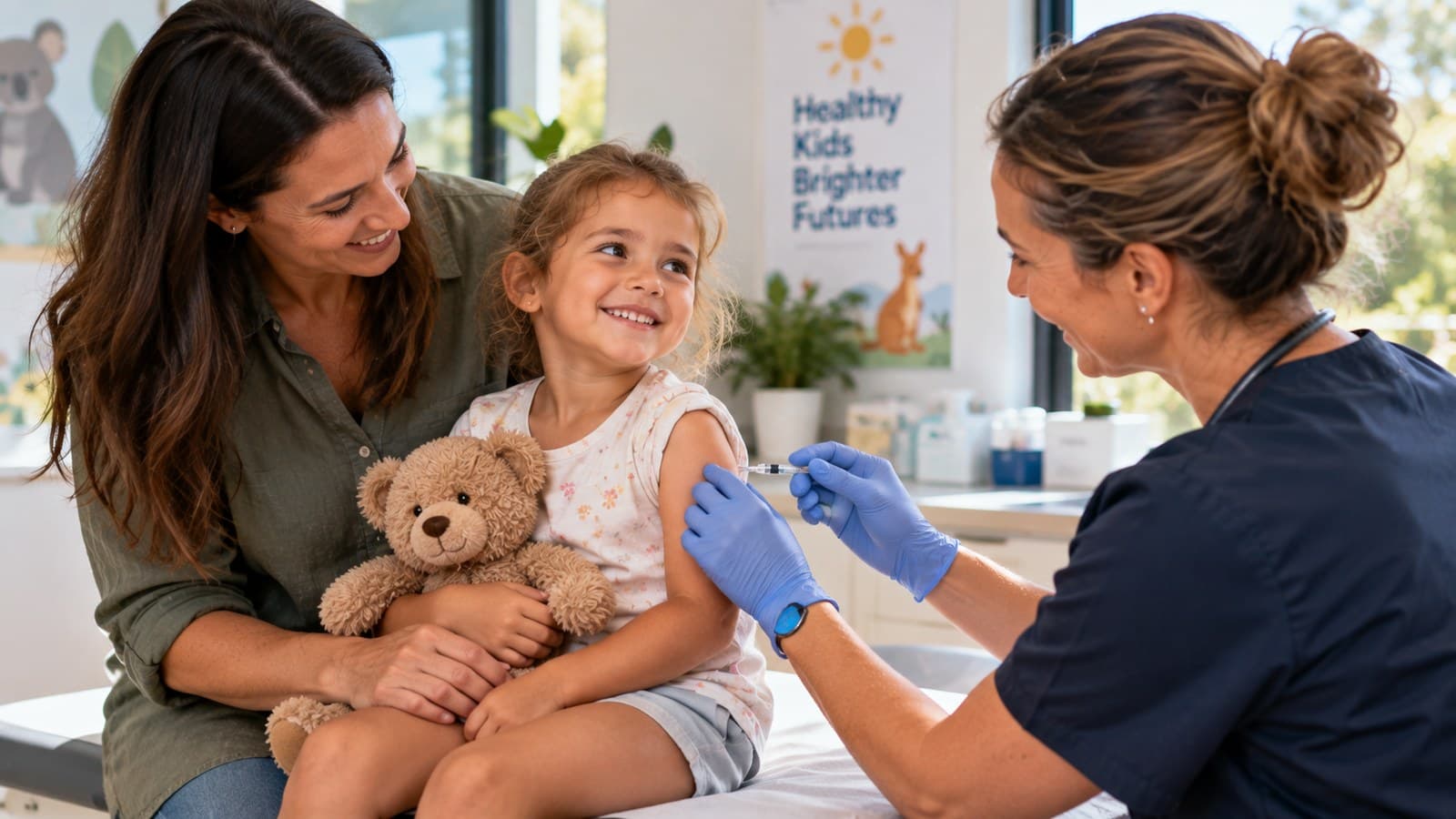
A practical Australian guide to the routine vaccine schedule, catch-up doses and what parents can expect
Childhood vaccination can feel complicated.
There are vaccines at birth, several visits during the first year, boosters later in childhood, school-based vaccines in adolescence, and extra recommendations for some children.
Fortunately, parents do not need to memorise the whole schedule.
Australia has a National Immunisation Program, or NIP, that funds routine vaccines for eligible children at specific ages. State and territory programs may also fund additional vaccines.
The most useful approach is simple:
Keep your child’s vaccination record up to date, attend the scheduled visits, and ask your GP or immunisation provider to check for anything that has been missed.
Why vaccinate children?
Vaccines train the immune system to recognise particular infections before a child is exposed to them.
Routine childhood vaccination protects against diseases that can cause serious illness, disability or death, including:
- whooping cough
- measles
- meningococcal disease
- pneumococcal disease
- polio
- tetanus
- hepatitis B
- Haemophilus influenzae type b, or Hib.
Some of these infections are now uncommon in Australia because vaccination has worked well.
That does not mean they have disappeared.
Measles, whooping cough and other vaccine-preventable diseases can still circulate or be brought into Australia from overseas.
What is the National Immunisation Program?
The National Immunisation Program funds recommended routine vaccinations for eligible infants, children, adolescents and adults in Australia.
For children, the main routine schedule includes vaccination at:
- birth
- around 2 months
- 4 months
- 6 months
- 12 months
- 18 months
- 4 years
- adolescence.
Some vaccinations are also recommended annually, particularly influenza.
There are extra funded vaccines for some Aboriginal and Torres Strait Islander children and children with certain medical conditions.
The schedule can change over time, so the current NIP schedule and Australian Immunisation Handbook should always be used rather than relying on an old fridge magnet or baby book.
The routine childhood schedule
The following is a practical summary of the current national schedule in 2026.
Birth
Routine vaccination includes:
- hepatitis B
It is usually offered in hospital.
The greatest benefit is when the birth dose is given within the first 24 hours, and the national schedule states that it should be given within 7 days.
Around 2 months
This appointment can usually occur from 6 weeks of age.
Routine vaccines protect against:
- diphtheria
- tetanus
- whooping cough
- hepatitis B
- polio
- Hib
- rotavirus
- pneumococcal disease.
Aboriginal and Torres Strait Islander children also receive funded meningococcal B vaccination at this age under the current national schedule.
The current NIP uses Rotarix for rotavirus vaccination. The first dose must be given before 15 weeks of age, so rotavirus is one part of the schedule that should not simply be delayed.
4 months
The next scheduled doses include protection against:
- diphtheria
- tetanus
- whooping cough
- hepatitis B
- polio
- Hib
- rotavirus
- pneumococcal disease.
Aboriginal and Torres Strait Islander children receive another meningococcal B dose.
The second Rotarix dose must be given before 25 weeks of age.
6 months
Routine vaccination includes another dose protecting against:
- diphtheria
- tetanus
- whooping cough
- hepatitis B
- polio
- Hib.
Some children also need additional pneumococcal vaccination at this age, including:
- Aboriginal and Torres Strait Islander children; and
- children with specified medical risk conditions.
Some Aboriginal and Torres Strait Islander children with particular medical risk conditions may also need an additional meningococcal B dose.
Influenza from 6 months of age
Under the National Immunisation Program, all children aged 6 months to under 5 years are eligible for funded annual influenza vaccination.
Healthy children aged 6 months to under 2 years receiving influenza vaccine for the first time should receive 2 doses at least 4 weeks apart.
From age 2 years, most healthy children need one influenza dose each year, even if they have not previously received influenza vaccine.
Children aged 6 months to under 9 years with certain medical risk conditions may still need 2 doses in their first year of influenza vaccination.
For children aged 5 years and older, annual influenza vaccination remains funded for certain higher-risk groups, including Aboriginal and Torres Strait Islander children and children with specified medical conditions.
Because the influenza vaccine is updated each year, last year’s vaccine does not replace this year’s recommended dose.
12 months
Routine vaccination includes protection against:
- meningococcal ACWY
- measles, mumps and rubella — MMR
- pneumococcal disease.
Aboriginal and Torres Strait Islander children also receive meningococcal B vaccination at 12 months.
18 months
Routine vaccines include:
- Hib
- measles, mumps, rubella and varicella — chickenpox
- diphtheria, tetanus and whooping cough.
Aboriginal and Torres Strait Islander children in Western Australia, Northern Territory, South Australia and Queensland also receive hepatitis A vaccination through the national schedule.
4 years
Routine vaccination includes a booster against:
- diphtheria
- tetanus
- whooping cough
- polio.
Some children may also need catch-up pneumococcal vaccination depending on their age, previous doses and risk factors.
School-age and adolescent vaccines
Vaccination continues beyond preschool.
At around 12–13 years, usually through the Year 7 school program or age-equivalent services, routine vaccination includes:
- human papillomavirus — HPV
- a booster against diphtheria, tetanus and whooping cough.
The current NIP schedule uses one HPV dose for most immunocompetent adolescents.
If the routine HPV dose was missed, funded catch-up remains available up to and including 25 years of age.
At around 14–16 years, usually Year 10 or age equivalent, adolescents receive meningococcal ACWY vaccination.
Why are there several vaccines in one appointment?
Parents sometimes worry that several vaccinations at once may be “too much” for a baby’s immune system.
Combination vaccines allow protection against several diseases with fewer injections.
The Australian schedule is deliberately designed so vaccines can be given together safely when recommended.
Giving vaccines at the scheduled time also means a child becomes protected earlier rather than remaining vulnerable while doses are unnecessarily spread out.
What if my child is late for a vaccine?
Do not panic.
In almost all cases, you do not start the whole vaccination schedule again.
Instead, your GP or immunisation provider works out which documented doses have already been given and builds a catch-up schedule from there.
Valid previous doses generally still count, even when a long interval has passed.
The aim of catch-up vaccination is to restore protection as quickly as possible while keeping the correct minimum intervals between doses.
Are catch-up vaccines free?
Under the current NIP, people aged under 20 years are generally eligible for funded catch-up of routine childhood NIP vaccines they missed.
HPV catch-up is funded up to and including 25 years of age.
Special arrangements also apply to refugees and humanitarian entrants.
Your practice can check both the National Immunisation Program and any additional NSW-funded programs.
What if we do not have the vaccination records?
This is common after:
- moving
- changing practices
- vaccination overseas
- separation of parents
- lost baby records.
The Australian Immunisation Register — AIR — is the national vaccination register.
Your child’s Immunisation History Statement shows vaccinations that have been recorded there.
If a vaccination may have been given but is missing from AIR, the provider may try to obtain records from the clinic that gave it.
If reliable records cannot be found, your immunisation provider can work out an appropriate catch-up plan using the Australian Immunisation Handbook.
Valid documented doses are counted, and vaccines should not simply be repeated unnecessarily.
My child was vaccinated overseas — does it count?
Often, yes.
Vaccines given overseas may count if the vaccination, age at administration and dose interval are considered valid under Australian recommendations.
However, countries use different:
- vaccine brands
- combinations
- schedules
- ages
- dose numbers.
Bring any overseas vaccination documentation you have.
Your provider can compare it with the Australian schedule and plan catch-up only where necessary.
Which children need extra vaccines?
The routine schedule is the starting point.
Some children need additional vaccination because their risk of serious infection is higher.
Examples may include children with:
- no spleen or poor spleen function
- some immune deficiencies
- certain chronic medical conditions
- treatments that suppress the immune system
- particular heart, lung or kidney conditions.
Depending on the condition, extra pneumococcal, meningococcal, influenza, Hib or other vaccines may be recommended.
A child with significant medical conditions should have vaccination recommendations checked against the Australian Immunisation Handbook, not just the basic routine schedule.
Aboriginal and Torres Strait Islander children
The NIP includes some additional funded vaccines because the risk of certain infections and complications is higher in Aboriginal and Torres Strait Islander communities.
Current examples include:
- meningococcal B vaccination during infancy
- additional pneumococcal vaccination in infancy
- annual influenza vaccination beyond age 5
- hepatitis A vaccination for children in WA, NT, SA and Queensland.
Exact recommendations depend on age, state or territory, previous vaccines and medical risk.
What about RSV?
Respiratory syncytial virus, or RSV, can cause severe respiratory illness in babies.
Australia’s current NIP includes RSV vaccination during pregnancy, generally between 28 and 36 weeks, to help protect the baby after birth.
States and territories may also provide RSV protection for some infants using a long-acting monoclonal antibody.
This is a form of immunisation, but it is not the same as a vaccine.
This is a good example of why a childhood immunisation plan sometimes starts before the baby is born.
What happens at a vaccination appointment?
The immunisation provider should check:
- which vaccinations are due
- previous vaccination history
- allergies
- previous serious vaccine reactions
- current health
- whether any special medical-risk recommendations apply.
Minor illnesses such as a simple cold do not always require vaccination to be postponed.
If your child is significantly unwell, your provider can decide whether vaccination should be delayed.
After vaccination, you may be asked to remain at the clinic for around 15 minutes because severe allergic reactions, while very rare, usually occur soon after vaccination.
What side effects are normal?
Most vaccine reactions are mild and temporary.
Common effects include:
- pain or redness where the injection was given
- mild swelling
- mild fever
- tiredness or irritability.
These usually settle within a day or two.
Some vaccines have particular expected reactions that occur later, so your immunisation provider should tell you what to expect for the vaccines given that day.
Should I give paracetamol before vaccination?
Not routinely for every vaccine.
There is an important exception.
Prophylactic paracetamol is specifically recommended with every Bexsero meningococcal B dose in children under 2 years, because fever is more common after this vaccine, particularly when it is given with other routine childhood vaccines.
For other vaccines, paracetamol can be used when clinically appropriate for discomfort or fever, following age-appropriate instructions.
Ask your provider if you are unsure.
When should I seek medical help?
Serious reactions to vaccination are rare.
Seek prompt medical advice if your child has a reaction that seems:
- severe
- unusual
- prolonged
- or concerning to you.
Get urgent medical help for symptoms suggesting a severe allergic reaction, such as:
- difficulty breathing
- swelling or widespread hives
- persistent cough or hoarse voice
- sudden significant distress or collapse.
After rotavirus vaccination, there is also a very small risk of intussusception, a bowel condition, especially in the week after the first or second dose.
Seek urgent assessment if a baby develops:
- severe episodes of crying or abdominal pain
- unusual pallor or marked distress
- repeated drawing of the legs towards the abdomen.
If your child is seriously unwell or having difficulty breathing, call 000.
What if my child had a reaction last time?
A previous reaction does not automatically mean future vaccination is unsafe.
Most children who have had a reaction can still be vaccinated safely.
The important question is what actually happened.
A sore arm or fever is very different from a true severe allergic reaction.
If your child had a serious or unusual reaction, tell the immunisation provider before the next dose.
Specialist immunisation advice can be arranged when necessary.
A common misconception
MYTH: If my child’s vaccines are late, we have to start everything again.
REALITY: Almost never.
Valid previous doses generally still count.
The provider calculates the remaining doses and the shortest safe intervals required to complete protection.
The important thing is to restart the process, not the entire vaccine course.
Questions parents commonly ask
Can several vaccines be given at the same appointment?
Usually, yes.
The schedule is designed to allow recommended vaccines to be given together when appropriate.
My child has a cold. Do we need to cancel?
Not necessarily.
A mild illness does not automatically prevent vaccination.
If your child is significantly unwell or has a high fever, speak with your provider.
Will vaccination records automatically appear on AIR?
Vaccination providers are required to report relevant vaccinations to the Australian Immunisation Register, but errors or delays can occur.
It is worth checking the Immunisation History Statement if something appears missing.
Does my child need flu vaccination every year?
All children aged 6 months to under 5 years are funded for annual influenza vaccination through the NIP.
Older children may also qualify because of Aboriginal and Torres Strait Islander status or specified medical risk conditions.
What if we missed the school vaccination day?
Contact your GP, council immunisation service or another vaccination provider.
A missed school visit does not mean the opportunity is lost.
How to prepare for the appointment
If possible:
- bring any vaccination records not already on AIR
- tell the provider about previous serious reactions
- mention significant medical conditions or immune-suppressing treatment
- dress younger children in clothes that make the thigh or upper arm easy to access
- allow time to remain at the clinic briefly afterwards
- ask what vaccines were given and when the next ones are due.
For older children, explaining beforehand that there will be a quick needle is often better than surprising them at the last moment.
Start with one question
At your child’s next GP visit, ask:
“Can we check AIR and make sure every vaccination is up to date?”
It takes much less time to find a missing dose now than to discover it years later.
The bottom line
Australia’s childhood vaccination schedule protects children at the ages when they are most vulnerable to serious infection.
The main routine schedule includes vaccination at:
birth → 2 months → 4 months → 6 months → 12 months → 18 months → 4 years → adolescence
with annual influenza vaccination from 6 months to under 5 years and additional recommendations for some children.
If vaccines have been missed, the answer is usually not to start again.
It is to:
check the record, calculate what is missing, and catch up safely.
Related Q Guides

Dr Quinten Willemse
Important information
This guide provides general health information and does not replace personalised medical advice. Speak with your GP or healthcare professional about recommendations appropriate to your medical history and circumstances.