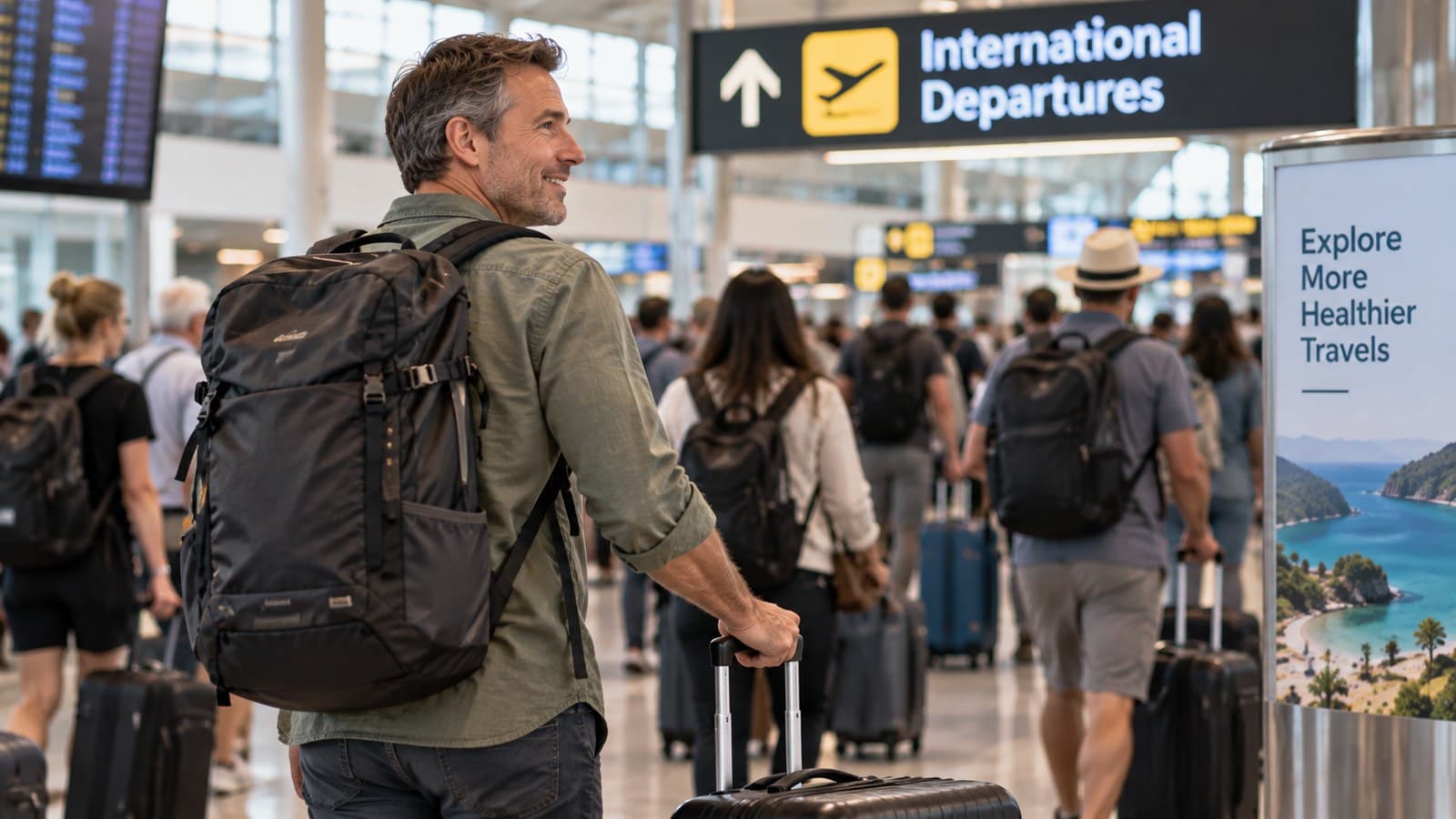
A practical Australian guide to travel vaccines, malaria prevention and preparing before an overseas trip
Travel health is not just about getting “the travel needles”.
The right preparation depends on:
- where you are going;
- how long you will be there;
- what you will be doing;
- where you will be staying;
- your age;
- your medical history;
- your routine vaccination history;
- whether you are pregnant or immunocompromised.
Two people flying to the same country may need very different advice.
That is why a good travel-health appointment starts with your itinerary, not a standard list of vaccines.
Ideally, this should happen several weeks before you leave — but even if your trip is close, it is still worth asking.
When should I book?
Ideally, arrange your travel-health appointment 6–12 weeks before departure, particularly if you are travelling somewhere with complex vaccination requirements, malaria risk or yellow fever requirements.
Why so early?
Because some vaccines:
- require more than one dose;
- need time for immunity to develop;
- may need to be spaced apart;
- can interact with other live vaccines;
- are available only through particular providers.
You may also need time to arrange:
- malaria prevention;
- travel prescriptions;
- yellow fever certification;
- catch-up vaccination;
- further medical assessment.
But if you are leaving next week, do not assume it is too late.
Some vaccines can still provide useful protection shortly before travel, and accelerated schedules may sometimes be possible.
The best approach is: come as early as you can, even if “early” is only a few days before departure.
Start with your routine vaccinations
Travel vaccination begins with checking the vaccines you should already have received.
Depending on your age and previous history, this may include:
- measles, mumps and rubella;
- tetanus, diphtheria and whooping cough;
- influenza;
- COVID-19 where recommended;
- polio;
- hepatitis B;
- other ageor risk-based vaccines.
Routine diseases such as measles may be more common overseas than they are in Australia.
So before worrying about an exotic travel vaccine, it is worth asking: “Am I actually up to date with the basics?”
Which travel vaccines might I need?
There is no universal “travel vaccine package”.
Depending on your destination and itinerary, vaccines may include:
- hepatitis A;
- hepatitis B;
- typhoid;
- yellow fever;
- meningococcal vaccines;
- Japanese encephalitis;
- rabies;
- polio boosters;
- influenza;
- routine childhood or adult catch-up vaccines.
The correct choice depends on:
- country;
- region within that country;
- rural versus urban travel;
- trip duration;
- accommodation;
- activities;
- season;
- individual medical risk.
A short city holiday and a six-week rural cycling trip may require completely different planning.
Hepatitis A
Hepatitis A spreads mainly through contaminated food and water.
Vaccination is commonly considered for travellers to areas where hepatitis A is more prevalent, particularly when food and water hygiene may be uncertain.
A first dose can provide useful protection before travel, while later doses help provide longer-term protection.
Typhoid
Typhoid fever is also spread mainly through contaminated food and water.
Vaccination may be recommended particularly when:
- sanitation is limited;
- travel is prolonged;
- you are staying with local families;
- food hygiene may be uncertain;
- you are travelling outside major tourist areas.
Vaccination reduces the risk. It does not make unsafe food or water safe.
Yellow fever
Yellow fever deserves special attention because it can involve both:
- protection against a serious mosquito-borne infection; and
- international vaccination certificate requirements.
Vaccination is generally recommended for travellers aged 9 months and older who are going to areas with a risk of yellow fever transmission, unless there is a medical reason not to vaccinate.
Some countries may also require a valid yellow fever certificate for entry, particularly depending on where you have recently travelled or transited.
That means yellow fever is one of the vaccines where your exact route matters, not just your final destination.
Where do I get a yellow fever vaccine?
Yellow fever vaccination must be provided through an authorised yellow fever vaccination centre.
The authorised centre can provide the recognised International Certificate of Vaccination or Prophylaxis when vaccination is appropriate.
Mingara Medical is an authorised yellow fever vaccination centre.
This means eligible patients can have their travel-health assessment, yellow fever vaccination and certification arranged through the practice when appropriate.
If this is your first yellow fever vaccination, allow at least 10 days before travel where a valid certificate is required.
If yellow fever may be relevant to your trip, mention this when you book so sufficient time can be allowed for the consultation, vaccination and documentation.
Does yellow fever vaccination last forever?
For most healthy travellers, one yellow fever vaccination provides long-lasting protection, and the international certificate is generally valid for life.
Some travellers may still be advised to have a booster if their previous dose was many years ago and they are returning to an area with significant ongoing exposure risk or have particular medical circumstances.
Bring any old yellow fever certificate if you have one. It may save you from unnecessary repeat vaccination.
Japanese encephalitis
Japanese encephalitis, or JE, is transmitted by mosquitoes. It occurs in parts of Asia and the Western Pacific.
Vaccination may be more relevant for:
- longer stays;
- rural or agricultural travel;
- substantial outdoor exposure;
- travel during periods of increased transmission;
- particular destinations or activities.
Someone spending three nights in a large city hotel may have very different risk from someone spending six weeks in rural areas.
Rabies
Pre-travel rabies vaccination may be worth considering when the chance of animal exposure is higher.
This can include:
- long trips;
- cycling or running;
- animal work;
- travel with children;
- remote areas where medical care may be difficult to reach.
Even if you have had pre-travel rabies vaccination, an animal bite or scratch still requires urgent medical attention.
Pre-travel vaccination makes post-exposure treatment simpler. It does not mean you can ignore an exposure.
One of the easiest travel rules is: Do not pat dogs, cats, monkeys or other mammals overseas simply because they look friendly.
Meningococcal vaccination
Meningococcal vaccination may be recommended because of:
- destination risk;
- outbreaks;
- crowded travel;
- pilgrimage;
- entry requirements.
Some countries require proof of a particular meningococcal vaccination.
This is another reason to bring the full itinerary rather than saying only: “I’m going to the Middle East.”
Polio
Polio has been eliminated from Australia, but poliovirus still circulates in some parts of the world.
Depending on destination and current international requirements, a traveller may need:
- routine catch-up;
- a booster;
- documentation of recent vaccination.
These recommendations can change when outbreaks occur.
Vaccines are only part of travel health
Some important travel infections have no routine vaccine.
Examples include:
- malaria;
- dengue;
- chikungunya;
- Zika;
- many causes of traveller’s diarrhoea.
That means mosquito precautions, food safety and sensible travel behaviour can be just as important as vaccination.
Malaria
Malaria is transmitted by mosquitoes. It occurs in parts of Africa, Asia, the Pacific, and Central and South America.
Whether malaria tablets are recommended depends on much more than the country name.
Risk can vary by:
- region;
- altitude;
- season;
- rural versus urban travel;
- accommodation;
- length of stay;
- current malaria patterns.
Which malaria medication is best?
There is no single “best malaria tablet”.
The right choice depends on:
- destination;
- local resistance patterns;
- age;
- pregnancy;
- kidney function;
- other medicines;
- previous side effects;
- how soon you are leaving;
- how long you will be away.
Different medications also have different schedules before, during and after travel.
As part of a travel-health consultation, I can prescribe appropriate malaria prophylaxis when it is indicated, based on the traveller’s itinerary and medical history.
The goal is not simply to prescribe a tablet. It is to choose the right medication for the right trip.
Mosquito avoidance still matters
Even when malaria medication is prescribed, mosquito precautions remain important.
No malaria medication is completely protective.
Useful measures include:
- effective insect repellent;
- long sleeves and trousers when practical;
- screened or air-conditioned accommodation;
- mosquito nets when needed.
These precautions also help reduce infections such as dengue, Zika and chikungunya.
What other travel medicines might be useful?
Depending on your itinerary and health, a travel consultation may also include prescriptions or advice for:
- traveller’s diarrhoea;
- nausea or vomiting;
- altitude-related illness;
- motion sickness;
- regular medication supplies;
- allergy or asthma treatment;
- other destination-specific risks.
These should be selected for the individual traveller, rather than copied from a generic packing list.
More medication is not automatically better preparation.
What if I am pregnant?
Pregnancy changes travel-health decisions.
Some infections are more dangerous during pregnancy, while some vaccines and medicines may not be suitable.
Live vaccines need particular consideration.
Yellow fever vaccination, for example, may occasionally be considered if travel is unavoidable and the infection risk is substantial, but this requires an individual risk-benefit assessment.
Malaria can also be particularly dangerous during pregnancy, and the choice of preventive medication becomes more limited.
If you are pregnant, breastfeeding, or trying to conceive, mention this before vaccines or medications are prescribed.
What if I am immunocompromised?
Tell your travel-health clinician.
Immunocompromise can affect:
- which vaccines are safe;
- whether live vaccines can be used;
- how well vaccines are likely to work;
- whether extra doses are needed;
- whether a particular destination is sensible.
For some travellers, changing or postponing a high-risk itinerary may be safer than trying to vaccinate around significant immune suppression.
Travelling with children
Children need their own assessment.
They may require:
- routine catch-up vaccines;
- destination-specific vaccines;
- malaria prevention;
- earlier scheduling because some vaccines have minimum ages.
Children may also be more likely to touch animals, become dehydrated quickly, struggle to describe symptoms, or have age restrictions on medications.
A family travel-health appointment should assess each traveller individually.
Do not simply assume the children need whatever their parents need.
Visiting friends and relatives
Travellers visiting friends and relatives sometimes underestimate risk because the destination feels familiar.
But these trips may involve longer stays, local food, residential accommodation, rural travel and close community exposure.
Being born in a country does not mean you remain protected indefinitely against infections found there.
Current vaccination status still matters.
Cruises and resort holidays
Not every overseas holiday needs multiple travel vaccines.
A short cruise or resort holiday may mainly require:
- routine vaccination review;
- influenza;
- food and water advice;
- mosquito protection.
But the risk can change if the trip includes rural excursions, jungle travel, animal exposure, long stopovers or travel through yellow fever areas.
Again: the itinerary matters more than the label on the holiday brochure.
Can several travel vaccines be given together?
Often, yes.
Many vaccines can be given during the same visit.
However, timing matters with some live vaccines.
If two injectable live vaccines are not given on the same day, they may need to be separated by around four weeks.
Your provider can work out the safest and fastest schedule.
Can I get everything at the airport?
Usually not a good plan.
The problem is not simply finding a clinic.
Vaccines need time to work. Some require multiple doses.
Yellow fever certification also has specific requirements, including the 10-day interval after a first dose before the certificate becomes valid.
Travel health is best treated as preparation, not something added between security and boarding.
Are travel vaccines covered by Medicare?
The consultation may attract Medicare benefits when usual Medicare requirements are met.
However, many travel-specific vaccines are not funded through the National Immunisation Program for routine travellers and may need to be purchased privately.
Costs vary between vaccines and clinics.
Ask about both consultation and vaccine costs when you book.
What records should I bring?
Bring whatever you have, including:
- Australian Immunisation Register history;
- old travel vaccine records;
- childhood vaccination records;
- yellow fever certificates;
- medication lists;
- specialist information if relevant.
If you have had travel vaccines before, do not assume you need them again.
Good records can save both money and unnecessary injections.
Your itinerary matters more than the country name
For a useful consultation, provide:
- every country you will visit;
- travel dates;
- cities and regions;
- rural versus urban travel;
- accommodation;
- length of stay;
- planned activities;
- whether you are visiting friends or relatives;
- animal exposure;
- trekking or cycling;
- healthcare or volunteer work;
- stopovers and transits.
Transit can matter.
For example, yellow fever certificate requirements may depend on where you have recently travelled or transited, not just where your flight ends.
Check Smartraveller
Travel-health advice changes.
Smartraveller provides current Australian Government advice on:
- infectious disease outbreaks;
- entry requirements;
- local medical care;
- security;
- natural disasters;
- travel insurance;
- destination-specific health risks.
Check your destination again shortly before departure.
An outbreak after your first consultation may change the advice.
What happens at a travel-health appointment?
A travel-health appointment may include:
- reviewing the itinerary;
- checking routine vaccines;
- deciding which travel vaccines are worthwhile;
- assessing yellow fever risk and certificate requirements;
- reviewing malaria risk;
- prescribing malaria medication where appropriate;
- checking regular medicines;
- pregnancy or contraception considerations;
- mosquito precautions;
- food and water advice;
- animal-bite prevention;
- managing traveller’s diarrhoea;
- planning for medical care overseas.
You may not need everything on this list.
The consultation should match the trip.
A common misconception
MYTH: If I am staying in a good hotel, I do not need travel-health advice.
REALITY: Accommodation is only one part of risk.
You can still be exposed through food, mosquitoes, animals, local outbreaks, excursions, crowded transport and contact with friends and relatives.
A five-star hotel does not change whether malaria is present in the region or whether a yellow fever certificate is required.
Questions travellers commonly ask
I leave in two weeks. Is it too late?
No. Book as soon as possible. There may still be useful vaccines, prescriptions and advice.
Do I need every vaccine listed for the country?
No. Recommendations depend on your actual itinerary and health.
Do I need yellow fever vaccine for every trip to Africa or South America?
No. Both infection risk and certificate requirements vary by country, region and itinerary.
Can I get yellow fever vaccination at Mingara Medical?
Yes. Mingara Medical is an authorised yellow fever vaccination centre.
If yellow fever is relevant to your itinerary, the practice can assess whether vaccination is appropriate and arrange the recognised certificate.
If it is your first dose, remember that the certificate generally becomes valid 10 days after vaccination.
If I had yellow fever vaccine years ago, do I need it again?
Usually not for certification purposes.
Some higher-risk travellers may still be advised to receive a booster depending on their circumstances.
Bring your old certificate if possible.
Can I travel while pregnant?
Sometimes.
But your destination, vaccine requirements and malaria risk may substantially affect the decision.
Discuss high-risk travel before booking if possible.
Do I need travel insurance?
For most international travel, yes.
Medical treatment or evacuation overseas can be extremely expensive.
Travel insurance is separate from vaccination but is an important part of travel-health preparation.
How to prepare
Before your appointment, write down or bring:
- countries and regions;
- departure and return dates;
- accommodation;
- planned activities;
- vaccination records;
- current medicines;
- allergies;
- significant medical conditions;
- whether you are pregnant, breastfeeding or trying to conceive.
Do not just say: “I’m going to Asia.”
The difference between a week in central Tokyo and six weeks travelling through rural Southeast Asia can completely change the advice.
Start with one question
When you book, ask: “How early before my trip should I come in?”
And when you attend: bring the full itinerary.
The bottom line
Travel vaccination is not about collecting every vaccine available.
It is about matching prevention to your actual trip.
Start with routine vaccination.
Then ask:
Where am I going?
What infections occur there?
Which vaccines are recommended or required?
Is malaria prevention needed?
Do my age, pregnancy or medical conditions change the plan?
Ideally, arrange your travel-health review 6–12 weeks before departure.
But if you are travelling sooner, it is still worth asking.
At Mingara Medical, travel-health consultations can include:
routine and destination-specific vaccination advice;
yellow fever assessment, vaccination and certification when appropriate;
malaria prophylaxis and other relevant travel prescriptions;
practical advice tailored to the itinerary.
The best travel-health plan is the one designed for your itinerary, your risks and your health.
Related Q Guides

Dr Quinten Willemse
Important information
This guide provides general health information and does not replace personalised medical advice. Travel-health recommendations and international entry requirements can change. Check current Australian Government travel advice and discuss recommendations appropriate to your itinerary and medical history with your GP or travel-health professional.
Evidence and further reading
- Australian Immunisation Handbook — Vaccination for international travellers
- Australian Immunisation Handbook — Yellow fever
- Australian Government — National Guidelines for Yellow Fever Vaccination Centres and Providers, 10 April 2026
- Australian Government — Yellow fever
- Smartraveller — Health advice for travelling Australians
- Smartraveller — Infectious diseases