A practical guide to choosing the right heart test — and knowing when a scan may not help
“I want to check my heart. Should I get a calcium score?”
It is a common question.
The answer is not automatically yes.
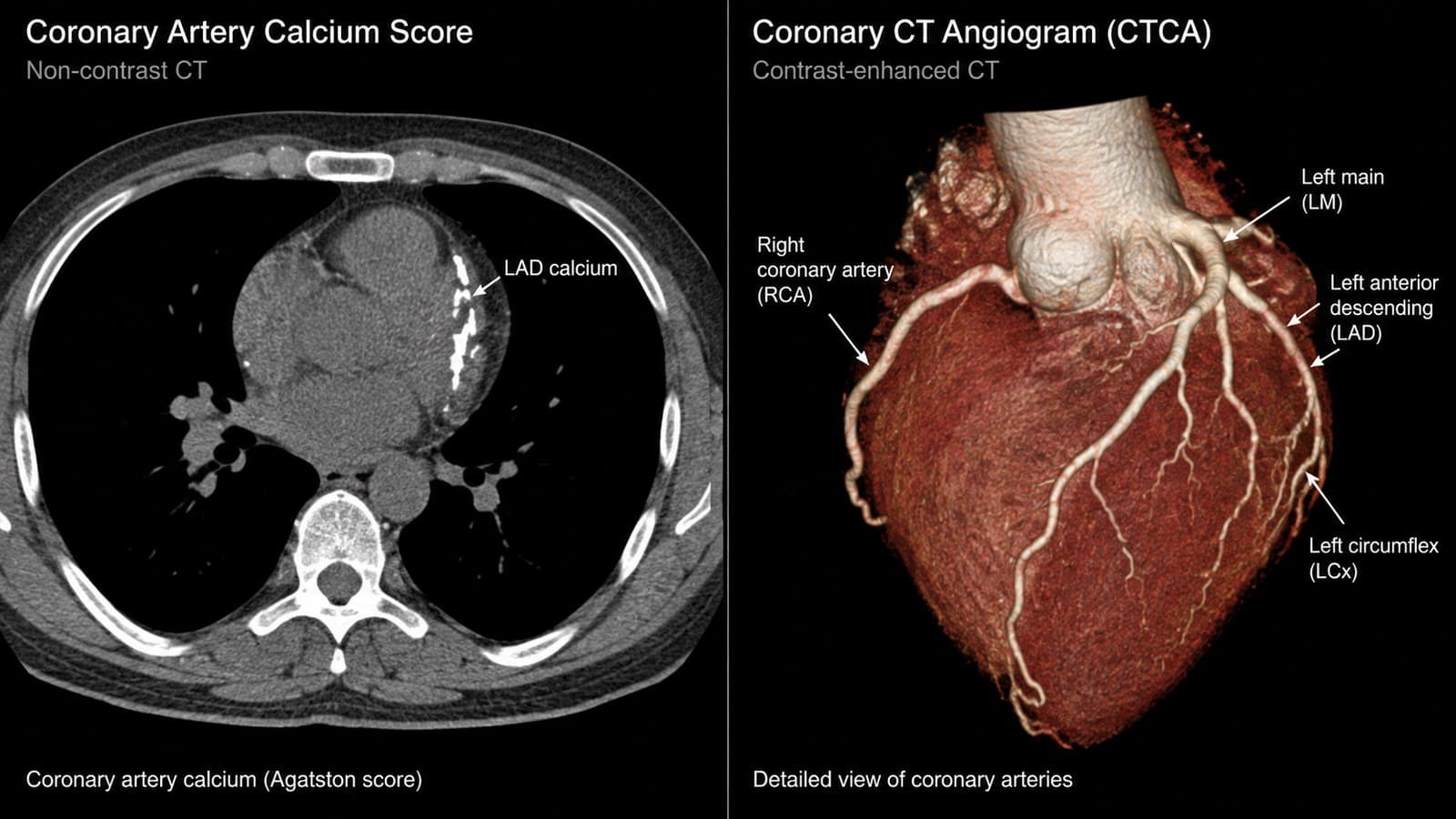
There are several ways to assess heart disease, and two CT-based tests are often confused:
- a coronary artery calcium score, or CAC score
- a CT coronary angiogram, or CTCA.
They are not interchangeable.
A calcium score is mainly a risk-assessment tool for selected people without symptoms.
A CT coronary angiogram is a more detailed test that can look directly at the coronary arteries and may be used when there is concern about actual coronary artery disease.
And for many people, the right answer is:
neither — at least not yet.
The best starting point is usually to work out what question we are trying to answer.
First: what are we looking for?
Coronary artery disease develops when plaque builds up in the arteries supplying the heart.
Plaque can be:
- calcified
- non-calcified or “soft”
- or a mixture of both.
Over time, plaque can narrow an artery or rupture and trigger a blood clot, causing a heart attack.
But there are two quite different clinical questions.
Question 1
“I feel well. What is my future risk of a heart attack or stroke?”
That is mainly a cardiovascular risk-assessment question.
A calcium score may occasionally help.
Question 2
“I have symptoms. Could one of my coronary arteries actually be narrowed?”
That is a diagnostic question.
A calcium score alone is not the right test for that.
Depending on the situation, CTCA, another cardiac investigation, cardiology assessment or urgent hospital assessment may be more appropriate.
What is a coronary artery calcium score?
A coronary artery calcium score is a quick CT scan of the heart that measures calcified plaque in the coronary arteries.
It does not usually require an injection or contrast dye.
The result is reported as a number, usually in Agatston units.
The higher the score, the greater the amount of calcified coronary plaque.
The Heart Foundation recognises CAC scoring as a possible tool for refining cardiovascular risk in selected people, rather than as a routine screening test for everybody.
A calcium score is not a general heart check
This is one of the most important points in this guide.
Current Australian cardiovascular guidance does not recommend coronary calcium scoring for general population screening.
In other words:
turning 40, 50 or 60 does not automatically mean you should book a calcium score.
It usually makes more sense to start with your overall cardiovascular risk.
Start with your cardiovascular risk
For people without known cardiovascular disease, current Australian guidance recommends formal cardiovascular risk assessment for:
- most adults aged 45–79 years
- people with diabetes aged 35–79 years
- First Nations people aged 30–79 years, with cardiovascular risk factors considered from younger adulthood.
The Australian CVD Risk Calculator looks at factors such as:
- age
- sex
- smoking
- blood pressure
- cholesterol
- diabetes
- kidney function and other diabetes-related measures where relevant
- some medications
- atrial fibrillation
- postcode and other risk considerations.
It estimates the chance of a cardiovascular event over the next 5 years.
Current Australian categories are:
- low risk: under 5%
- intermediate risk: 5% to under 10%
- high risk: 10% or more.
That assessment usually comes before deciding whether a scan would add anything useful.
When can a calcium score help?
The key word is uncertainty.
A calcium score can sometimes help when your initial risk assessment does not give a clear answer about how aggressively your cardiovascular risk should be treated.
Examples might include someone who:
- sits around an intermediate-risk range
- appears low risk on the calculator but has important additional risk factors
- has a strong family history of premature cardiovascular disease
- has a risk factor not fully reflected in the calculator
- is uncertain about starting long-term preventive treatment and where the result may meaningfully change the decision.
The Heart Foundation describes CAC as a reclassification factor.
That means it can add another piece of evidence when the initial risk estimate does not tell the whole story.
It is best thought of as:
an extra piece of information when the first answer is not quite clear enough.
When might a calcium score not help?
There are several common situations.
You are already clearly low risk
If your cardiovascular risk is low and there are no important additional concerns, a scan may be unlikely to change what you do.
You are already clearly high risk
If your existing risk factors already mean preventive treatment is recommended, finding coronary calcium may not change the plan.
You already have known coronary heart disease
A calcium score is mainly a primary prevention risk tool.
If you already have established coronary disease, treatment should be based on the known disease rather than using a calcium score to decide whether risk exists.
You have symptoms suggestive of coronary disease
This is particularly important.
A calcium score should not be used as the main test to investigate chest pain or other symptoms that might represent coronary artery disease.
That requires a different assessment.
What does a calcium score of zero mean?
A score of 0 means no calcified coronary plaque was seen.
That is generally reassuring.
In the right person, it may lower the estimated likelihood of a cardiovascular event and can sometimes influence decisions about preventive medication.
But zero does not mean:
- your arteries are guaranteed to be completely normal
- you cannot have non-calcified plaque
- you can ignore high blood pressure
- smoking no longer matters
- cholesterol no longer matters
- you cannot have a heart attack.
A calcium scan detects calcified plaque.
It does not exclude all coronary atherosclerosis.
Context still matters, particularly in younger people and in people with important risk factors.
What if the calcium score is positive?
A positive score means calcified coronary atherosclerosis is present.
Broadly:
more calcium generally means a greater burden of coronary plaque and higher cardiovascular risk.
The number should not be interpreted in isolation.
A higher CAC result — for example, a score above 99 Agatston units or a result at or above the 75th percentile for age and sex — can support reclassification to higher cardiovascular risk in an appropriate patient.
But a score of 100 does not mean:
“one artery is 100% blocked.”
A calcium score measures plaque burden.
It does not tell us directly how narrow each artery is.
That is an important difference from CTCA.
Does a high calcium score mean I need a stent?
No.
A calcium score is not a direct instruction to have an angiogram or stent.
The more useful question is usually:
“What should we now do to reduce my future risk?”
That may include reviewing:
- LDL cholesterol
- blood pressure
- smoking
- diabetes
- exercise
- nutrition
- weight
- appropriate preventive medicines.
Further cardiac investigation may be appropriate in some people, particularly if symptoms are present, but it is not automatic.
What is CT coronary angiography?
A CT coronary angiogram — CTCA — is a different scan.
It uses a specialised CT scanner and intravenous iodine-based contrast to create detailed images of the coronary arteries.
Rather than simply counting calcium, CTCA can show:
- coronary artery anatomy
- calcified plaque
- non-calcified plaque
- whether an artery appears narrowed
- the approximate severity and location of narrowing.
That makes CTCA much closer to a diagnostic anatomical test for coronary artery disease.
Calcium score versus CTCA
A simple way to remember the difference is:
Calcium score
Question: “How much calcified coronary plaque do I have, and does that change how we view my future risk?”
- mainly for selected people without symptoms
- no contrast injection
- measures calcified plaque
- does not directly show whether an artery is significantly narrowed
- generally used for risk refinement rather than diagnosis.
CTCA
Question: “What do my coronary arteries actually look like?”
- usually used when there is a clinical reason to investigate coronary disease
- uses intravenous contrast
- shows both calcified and non-calcified plaque
- can assess coronary narrowing
- requires more preparation and interpretation.
Should I get CTCA instead of a calcium score?
Not simply because it provides more information.
More information is not automatically better medicine.
CTCA may expose you to:
- radiation
- intravenous contrast
- incidental findings
- further testing
- minor abnormalities that may not explain symptoms.
It can be an excellent test when there is a genuine diagnostic question.
It is not designed as a routine whole-population “check my arteries” scan.
When might CTCA be considered?
One common Medicare-funded CTCA pathway is used for people with stable or acute symptoms consistent with coronary ischaemia who meet the relevant clinical criteria and are considered appropriate for CTCA rather than immediate invasive angiography.
Other recognised indications also exist.
The important patient message is simpler:
CTCA is generally ordered because there is a specific clinical question — not simply because someone wants a more detailed screening scan.
Can my GP order a Medicare-funded CTCA?
For the common Medicare-funded CTCA pathway used to investigate suspected coronary artery disease, the request must currently come from a specialist or consultant physician and the patient must meet the relevant MBS clinical criteria.
Other CTCA indications have separate Medicare rules.
So if I think CTCA may be the right next investigation, that may involve referral to a cardiologist or another appropriate specialist.
A GP may sometimes request CTCA outside that Medicare-funded pathway depending on local radiology arrangements, but Medicare eligibility is a separate question.
Medicare rules can change.
Is a calcium score covered by Medicare?
At present, routine coronary artery calcium scoring is not covered by Medicare, so patients generally pay privately for the test.
Cost varies between imaging providers.
That is another reason not to order the scan simply because it is available.
Ideally, we should know:
“What will I do differently depending on the result?”
before the scan is performed.
What about radiation?
Both calcium scoring and CTCA use X-rays and therefore involve ionising radiation.
Modern scanners can keep doses relatively low, but the exposure is not zero.
CTCA generally involves more complexity than a simple calcium scan and also requires contrast.
This does not make either test “dangerous” when appropriately used.
It simply reinforces a basic principle:
do a scan when the expected information is useful enough to justify the test.
What about contrast dye with CTCA?
CTCA usually requires intravenous iodine-based contrast.
The imaging service will consider issues such as:
- kidney function
- previous contrast reactions
- allergies
- pregnancy
- relevant medications.
Medication may also be used to optimise heart rate and improve image quality.
The radiology service will give you specific preparation instructions.
What about an exercise stress test?
Calcium scoring and CTCA are not the only heart tests.
Depending on your symptoms and clinical situation, your doctor may instead consider:
- an ECG
- exercise stress testing
- stress echocardiography
- myocardial perfusion imaging
- echocardiography
- cardiology assessment
- invasive coronary angiography.
Each test answers a different question.
A test should not be selected simply because it sounds newer or more advanced.
What if I have a strong family history?
This is where the discussion becomes more individual.
A family history of premature cardiovascular disease can increase risk and is recognised as an important reclassification factor.
Australian risk guidance generally considers premature family history to mean cardiovascular disease in a first-degree male relative before age 55 or a first-degree female relative before age 65.
So a father having a heart attack at 48 means something very different from a grandparent developing coronary disease at 88.
Depending on your age, cholesterol, blood pressure, smoking status and overall calculated risk, a calcium score may sometimes help refine the decision.
But a family history does not automatically mean you need a CTCA.
What if my cholesterol is high?
Again, the scan should not replace the basic assessment.
If cholesterol is very high — particularly where familial hypercholesterolaemia is suspected or confirmed — cardiovascular risk may already be sufficiently important to warrant treatment regardless of a calcium result.
A zero calcium score should not be used as permission to ignore severe inherited cholesterol risk.
This is why the sequence matters:
risk assessment first → scan only if it will genuinely help the decision.
A common misconception
MYTH: A calcium score tells me whether my arteries are blocked.
REALITY: It does not.
A calcium score measures the amount of calcified coronary plaque.
You can have:
- calcium without a major blockage
- non-calcified plaque that calcium scoring does not see
- symptoms that require investigation even with a calcium score of zero.
CTCA provides much more anatomical information about the artery itself.
Another common misconception
MYTH: If a heart scan is available, finding disease earlier must always be better.
REALITY: Testing is most useful when the result changes what we do.
Unnecessary imaging can lead to:
- cost
- radiation
- anxiety
- incidental findings
- further investigations.
Sometimes the highest-quality decision is not to scan.
When should I seek urgent help rather than arrange a heart scan?
Do not organise an outpatient calcium score because you are currently having concerning chest symptoms.
Seek urgent medical assessment for symptoms such as:
- chest pressure, heaviness or tightness
- chest discomfort triggered by exertion
- pain spreading to the arm, shoulder, jaw or back
- unexplained breathlessness
- sweating, nausea or collapse with chest discomfort
- severe or persistent new chest pain.
If you think you may be having a heart attack, call 000.
A calcium score is not a test for ruling out an acute coronary syndrome.
So which test should I have?
For many patients, I would think about it this way.
You feel well and simply want to “check your heart”
Start with:
blood pressure + cholesterol + diabetes assessment + smoking + family history + Australian CVD risk assessment.
You may need neither scan.
Your calculated risk is uncertain and a result could change prevention decisions
A coronary calcium score may be worth discussing.
You have symptoms that could represent coronary artery disease
A calcium score is not enough.
You need clinical assessment first.
Depending on the situation, CTCA or another cardiac investigation may be appropriate.
You already have clearly high cardiovascular risk
You may need treatment rather than another test to prove that risk exists.
You are having possible acute heart-attack symptoms now
Neither an outpatient calcium score nor a routine CTCA booking is the next step.
Seek urgent medical care.
The question I ask before ordering a scan
Before requesting any test, I like to ask:
“What will we do differently if the result is normal — and what will we do differently if it is abnormal?”
If neither answer changes the plan, the test may not be adding much.
That principle is particularly useful with heart scans.
The bottom line
A calcium score and a CT coronary angiogram answer different questions.
A calcium score:
- measures calcified coronary plaque
- is mainly a risk-refinement tool
- is most useful in selected people without symptoms
- is not a general screening test
- is not currently Medicare-funded.
A CTCA:
- looks directly at the coronary arteries
- uses contrast
- can detect both calcified and non-calcified plaque
- can show coronary narrowing
- is generally used when there is a specific diagnostic reason
- may attract Medicare benefits only when current referral and clinical criteria are met.
And sometimes the correct scan is:
neither.
Start with the question.
Then choose the test — if any — that can genuinely change what happens next.
Related Q Guides

Dr Quinten Willemse
Important information
This guide provides general health information and does not replace personalised medical advice. The most appropriate cardiac investigation depends on your symptoms, cardiovascular risk, medical history and examination. If you have severe or persistent chest pain, difficulty breathing, collapse or symptoms suggesting a heart attack, call 000.
Evidence and further reading
- Australian CVD Risk Assessment guideline / CVD Check
- CVD Check — Reclassification factors and other considerations
- National Heart Foundation of Australia — Coronary artery calcium scoring
- Medicare Benefits Schedule — CT coronary angiography item 57360
- Medicare Benefits Schedule — CT coronary angiography item 57364
- National Heart Foundation of Australia — patient information on CAC