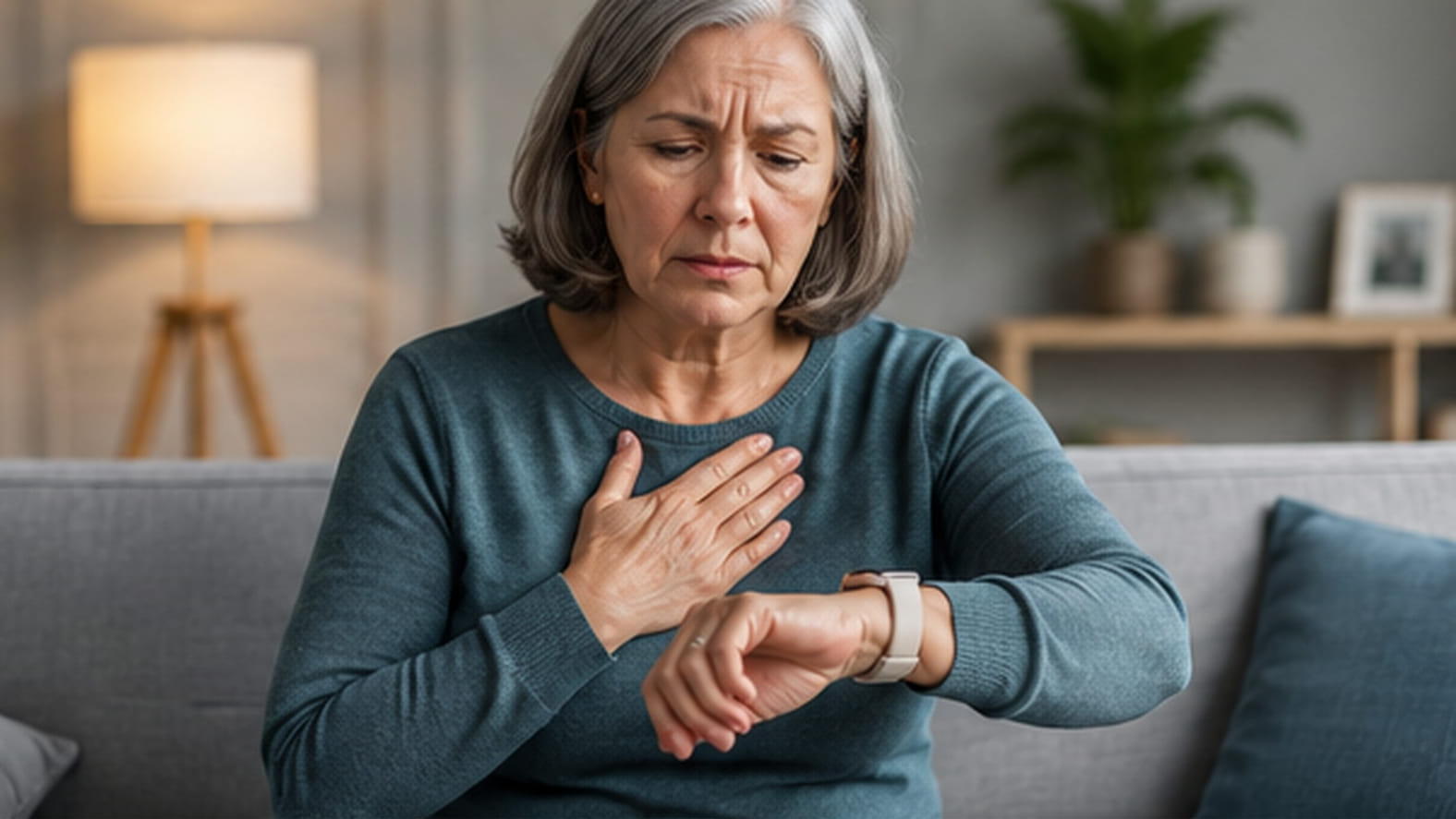
Why you may suddenly notice your heartbeat, what your GP may check, and when it needs urgent attention
Most of us are barely aware of our heartbeat.
Then suddenly it feels as though your heart is racing, pounding, fluttering or skipping a beat.
These sensations are called palpitations.
They are very common and are often caused by something harmless. But occasionally they are a sign of an abnormal heart rhythm or another medical problem.
The important part is not simply whether you have palpitations. It is what they feel like, how long they last, what you are doing when they occur, and whether anything else happens at the same time.
What are palpitations?
Palpitations are the sensation of being unusually aware of your heartbeat.
- racing
- pounding
- fluttering
- thumping
- skipping beats
- giving an occasional extra beat
- beating irregularly
Some episodes last only a second or two. Others continue for minutes or longer.
Palpitations do not automatically mean that your heart rhythm is abnormal. Many causes are not serious, although heart rhythm disorders can also cause them.
Why can I suddenly feel my heartbeat?
There are many possibilities.
- exercise
- stress or anxiety
- poor sleep
- caffeine
- alcohol
- nicotine
- dehydration
- fever or illness
- some medicines and stimulants
Sometimes the heart produces an extra beat, often called an ectopic or premature beat.
This can create a brief pause followed by a stronger beat. People often describe this as their heart ‘missing’ or ‘skipping’ a beat.
Other medical causes can include:
- an overactive thyroid
- anaemia
- electrolyte abnormalities
- heart valve problems
- abnormal heart rhythms, called arrhythmias
The pattern matters more than any one symptom in isolation.
Is it anxiety – or is it my heart?
Sometimes it is difficult to tell.
Anxiety can certainly cause a fast or forceful heartbeat. Adrenaline increases your heart rate and makes you more aware of physical sensations.
But feeling anxious during palpitations does not prove that anxiety caused them.
A sudden racing heart can itself make anyone anxious.
That is why recurrent or unexplained episodes should not automatically be dismissed as stress without first considering the overall pattern.
What is an arrhythmia?
An arrhythmia is an abnormal heart rhythm.
Some arrhythmias cause the heart to beat too quickly, too slowly or irregularly. Others cause brief extra beats that are harmless in many people.
One of the more important arrhythmias is atrial fibrillation, often shortened to AF.
In atrial fibrillation, the upper chambers of the heart beat irregularly. Some people notice racing or irregular palpitations, shortness of breath, dizziness or tiredness. Others have no symptoms at all.
AF matters because, in some people, it increases the risk of stroke and requires specific treatment.
That does not mean that most palpitations are atrial fibrillation.
The pattern can give useful clues
Did it start suddenly?
A heartbeat that goes from normal to very rapid almost instantly, then stops just as suddenly, can suggest a particular type of rhythm disturbance.
A gradual increase during exercise, anxiety or fever is a different pattern.
Is it regular or irregular?
A very fast but completely regular rhythm feels different from a chaotic or irregular heartbeat.
How long does it last?
A single ‘skip’ is different from a racing heart lasting 20 minutes.
What were you doing?
The context matters.
Palpitations during exercise deserve particular attention, especially if they occur with:
- chest discomfort
- unusual breathlessness
- dizziness
- fainting or near-fainting
What happened with it?
This is particularly important.
Palpitations accompanied by fainting, severe breathlessness or chest pain deserve much more urgent assessment than an isolated brief flutter with no other symptoms.
When should I see my GP?
Book an appointment if:
- palpitations keep recurring
- episodes are lasting longer
- your heart rate suddenly becomes very fast without an obvious reason
- the rhythm feels persistently irregular
- symptoms occur during exercise
- you feel dizzy or light-headed during episodes
- there is a family history of serious heart rhythm problems or sudden cardiac death
- you have known heart disease
- you simply cannot explain why they are happening
A normal examination between episodes does not necessarily mean nothing happened.
Intermittent heart rhythm problems can disappear before you get to the doctor.
What will my GP want to know?
A good description can substantially improve the chance of finding the cause.
Your GP may ask:
- When did the palpitations start?
- How often do they happen?
- How long does each episode last?
- Do they begin and end suddenly?
- Does the heartbeat feel regular or irregular?
- What were you doing at the time?
- Were you exercising?
- Did you have chest pain, breathlessness, dizziness or fainting?
- How much caffeine or alcohol do you drink?
- Are you taking any new medicines or supplements?
- Is there a family history of heart disease, arrhythmia or sudden death?
This is one of those consultations where the story of the event really matters.
What tests might I need?
Not everyone with occasional palpitations needs extensive testing.
Your GP may check your:
- pulse
- blood pressure
- heart and lungs
- medicines
- general cardiovascular risk
An electrocardiogram, usually called an ECG, records the electrical activity of your heart.
The problem is that an ECG only shows what your heart is doing while the recording is being taken.
If the palpitations happen only occasionally, a normal ECG in the clinic does not rule out an intermittent rhythm problem.
In those situations, your GP may consider longer monitoring.
What is a Holter monitor?
A Holter monitor is a portable ECG recorder that monitors your heart rhythm over a longer period.
Depending on how often your symptoms occur, monitoring may be performed for a day, several days or sometimes longer using different devices.
The aim is simple: record the heart rhythm while you are actually having the symptoms.
This is often much more useful than repeatedly performing normal ECGs between episodes.
Can my smartwatch help?
Sometimes.
Many modern watches can record your pulse, alert you to unusual heart rates and, in some models, produce a simple ECG tracing.
That information can be genuinely useful.
If you can safely record an episode, save:
- the heart rate
- the rhythm tracing if available
- the time it happened
- how long it lasted
- what you were doing
- what symptoms you felt
But a watch should not become a source of constant checking.
Wearable devices can generate false alarms, miss abnormalities and cannot replace a clinical ECG or medical assessment.
Use the information as one piece of evidence, not as a diagnosis.
Do caffeine and alcohol cause palpitations?
They can in some people.
Large amounts of caffeine, energy drinks, nicotine and other stimulants can trigger palpitations.
Alcohol can also provoke abnormal rhythms in susceptible people, particularly after heavier intake.
You do not necessarily need to give up your usual coffee.
Instead, look for a consistent relationship between caffeine intake and your symptoms, particularly with large amounts or energy drinks.
If palpitations repeatedly occur after several coffees, an energy drink or a night of heavier alcohol intake, reducing that trigger is a sensible experiment.
Can medicines cause palpitations?
Yes.
Some cold and flu medicines, asthma medicines, stimulants and other prescription or non-prescription products can increase heart rate or cause palpitations.
Supplements and pre-workout products can also contain stimulants.
Bring a complete list of what you take to your appointment.
Do not stop an important prescribed medicine simply because palpitations have occurred. The medicine may or may not be responsible, and the safest next step is usually to discuss it with your GP.
When are palpitations an emergency?
Call 000 or seek emergency care now if palpitations occur with:
- severe or persistent chest pain
- severe shortness of breath
- fainting or collapse
- severe dizziness or feeling as though you are about to pass out
- symptoms suggesting a heart attack
- a very rapid heartbeat with severe or worsening symptoms
If you are feeling seriously unwell, do not drive yourself to hospital.
Questions people commonly ask
My heart sometimes skips one beat. Is that dangerous?
Usually not.
Occasional ectopic or premature beats are very common. Many healthy people notice them more when they are tired, stressed or using stimulants.
They deserve more attention if they are very frequent, worsening, occur with exercise, or are associated with fainting, chest pain or significant breathlessness.
My ECG was normal. Does that mean my heart is fine?
It is reassuring, but it does not answer every question.
An ECG records only a short period. If your palpitations had stopped before the ECG was performed, an intermittent rhythm disturbance may not appear.
That is why longer monitoring is sometimes needed.
My smartwatch says I have atrial fibrillation. Do I definitely have it?
No.
A wearable alert is worth taking seriously, particularly if it happens repeatedly, but it is not necessarily a confirmed diagnosis.
Save the tracing if possible and arrange medical review so the rhythm can be properly assessed.
My heart races when I am anxious. Do I need tests?
Not always.
If the pattern clearly occurs during anxiety, settles appropriately and there are no concerning features, extensive investigation may not be necessary.
But new, unexplained or recurrent racing episodes deserve an assessment before simply assuming anxiety is the cause.
Before your appointment
If possible, write down or record:
- when an episode happened
- how long it lasted
- your approximate heart rate
- whether it felt regular or irregular
- what you were doing
- any chest pain, breathlessness, dizziness or fainting
- caffeine, alcohol or stimulant intake beforehand
- any smartwatch recording
- your current medicines and supplements
Even two or three well-described episodes can be more useful than saying, ‘My heart sometimes feels funny.’
Start with one action
The next time you have a mild episode without emergency symptoms, note the time and check your pulse or wearable device if this is easy to do.
Ask yourself: Is it fast? Is it regular? How long does it last?
Then record the answer.
That small piece of information can make your next GP appointment much more useful.
The bottom line
Palpitations are common and often harmless.
The sensation may come from extra beats, stress, stimulants, illness or simply becoming more aware of your normal heartbeat.
But recurrent racing or irregular heartbeats can also represent an arrhythmia.
What matters most is the pattern and what happens alongside it.
A normal ECG between episodes can be reassuring without necessarily explaining intermittent symptoms. Recording an episode, whether with a monitor or sometimes a wearable device, can be valuable.
And if palpitations occur with fainting, severe chest pain or significant breathlessness, seek urgent medical care.
Related Q Guides

Dr Quinten Willemse
Important information
This guide provides general health information and does not replace personalised medical advice. Speak with your GP or healthcare professional about recommendations appropriate to your medical history and circumstances.
Call 000 or seek emergency care for severe chest pain, severe shortness of breath, fainting or other rapidly worsening symptoms.